Home › City Water Treatment › Is Tap Water Safe?
Is College Station Tap Water Safe to Drink?
Short answer: yes, by legal standards. College Station and Bryan treat, disinfect and test their water, and their most recent reports list no violations. Here is what the reports show, why the water tastes the way it does, and when a filter is worth it.
- Yes, by legal standards. Both cities' most recent reports list no violations, and chlorine and disinfection byproducts are below legal limits.
- What most people notice, a chlorine smell and a slightly salty taste, is about taste, not safety.
- Disinfection byproducts are below legal limits but detectable. Some families filter them out for peace of mind.
- Private wells are different. No one tests them but the owner.
Get your free water consultation →Take the 3-question online quiz. It takes under 30 seconds.
"Is the tap water safe?" is one of the first questions people ask after moving to Bryan or College Station, often because it smells a little like a pool or tastes a little salty. Those are fair questions. The good news is that the answer comes from public data: each city publishes an annual water quality report, and we pulled the key numbers below.
Where the water comes from
Both cities use groundwater, not a lake or river. College Station pumps from eight wells in the Simsboro Aquifer, plus one well each in the Carrizo and Sparta aquifers, all in northwest Brazos County. Bryan pumps from the Simsboro Aquifer. Deep groundwater like this is naturally well protected, and it is then disinfected with chlorine before it reaches your home.
What the latest reports show
| Measure | College Station | Bryan | Legal limit |
|---|---|---|---|
| Chlorine (average) | 1.66 ppm | 2.25 ppm | 4 ppm |
| TTHMs (byproduct) | Below limit | up to 42.3 ppb | 80 ppb |
| HAA5 (byproduct) | up to 2 ppb | up to 6 ppb | 60 ppb |
| Hardness | ~0.35 gpg | ~0.46 gpg | No limit |
| Dissolved solids (TDS) | ~557 ppm | ~680 ppm | 500 ppm taste guideline |
| Sodium | ~168 ppm | ~247 ppm | No federal limit |
A few notes on reading this table. Chlorine is added on purpose to keep water safe on its way through miles of pipe. TTHMs and HAA5 are disinfection byproducts, which form when chlorine reacts with natural material in water. Both cities are well under the legal limits, though the byproducts are detectable. The TDS guideline is a taste and appearance standard, not a health limit.
Legal vs. ideal. Bryan's disinfection byproducts reached 42 ppb in its 2025 report, about half the federal limit. That is legal and not alarming, but it is a fair reason some families choose carbon filtration for drinking and shower water.
Safe vs. great-tasting
"Safe" and "tastes great" are two different questions. Local water is safe by legal standards, but it has two traits people notice right away:
- Chlorine smell. Strongest in a hot shower or right after you turn on the tap. Here is how to get rid of the chlorine smell.
- Salty or flat taste. From naturally high sodium and dissolved solids in the aquifer. Here is why the water tastes salty.
When a filter makes sense
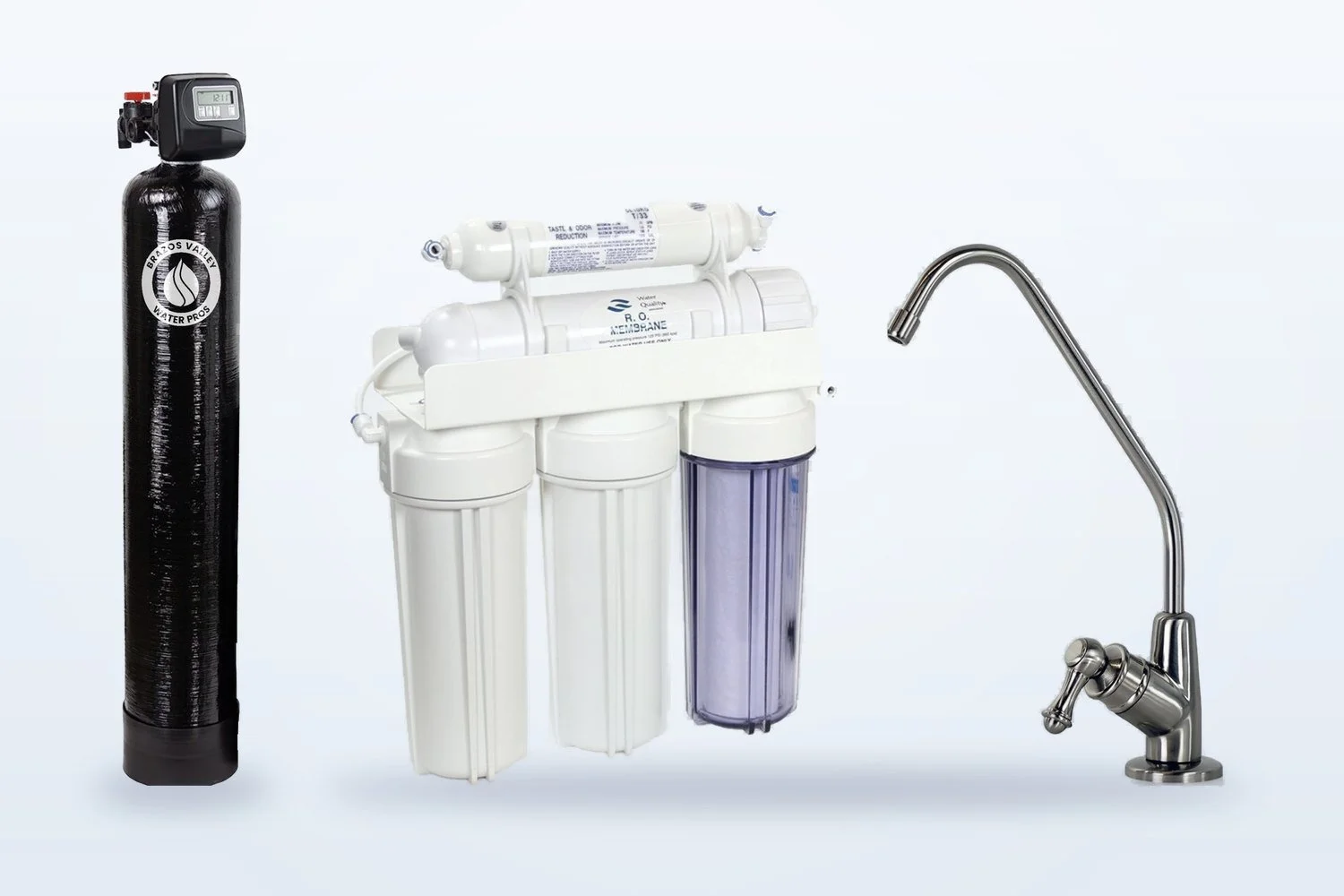
You do not need a filter for your water to be legally safe. People choose one for these reasons:
- You dislike the chlorine smell, or want lower disinfection byproducts in showers and drinking water. A whole-home carbon filter handles that at every tap.
- You dislike the salty taste, or you are on a sodium-restricted diet. Reverse osmosis at the kitchen sink removes about 90–95% of dissolved solids, including sodium.
- Your home has older plumbing. Water can pick up metals between the street and your faucet. A lab test of water from your own tap is the only way to know.
Not sure which one fits? See reverse osmosis vs. whole-home carbon filtration. One thing you almost certainly do not need on city water is a softener: here is why.
If you are on a private well
Everything above applies to city water. Private wells are not tested by the city, so their safety depends on the owner testing regularly. See what to test your well for and how often, or learn about well water treatment.
Common questions
Is College Station tap water safe to drink?
Is Bryan tap water safe to drink?
Why does my tap water smell like chlorine?
Why does College Station water taste salty?
Do I need to boil my tap water?
More Bryan & College Station water guides
- Why does my tap water taste salty?
- How to get rid of the chlorine smell in your tap water
- Reverse osmosis vs. whole-home carbon filter
- Do you need a water softener in College Station?
- Well water testing in the Brazos Valley
Find out what your water actually needs
Take the free 3-question online quiz, then talk with us by phone or text. We'll recommend a system based on your answers and what we see in water across your area. Every system is installed by licensed independent plumbers, with no high-pressure sales visit.
Get Your Free Water Consultation → Or call or text (979) 721-5597Figures are from the City of Bryan 2025 and City of College Station 2024 drinking water quality reports, and College Station's July 2026 water quality update. These reports are refreshed every July. Hardness, TDS and sodium come from earlier sampling years listed in those reports. Your home's water can vary; a test gives you exact numbers. This article is general information, not medical advice.